Rebundling Mathematics
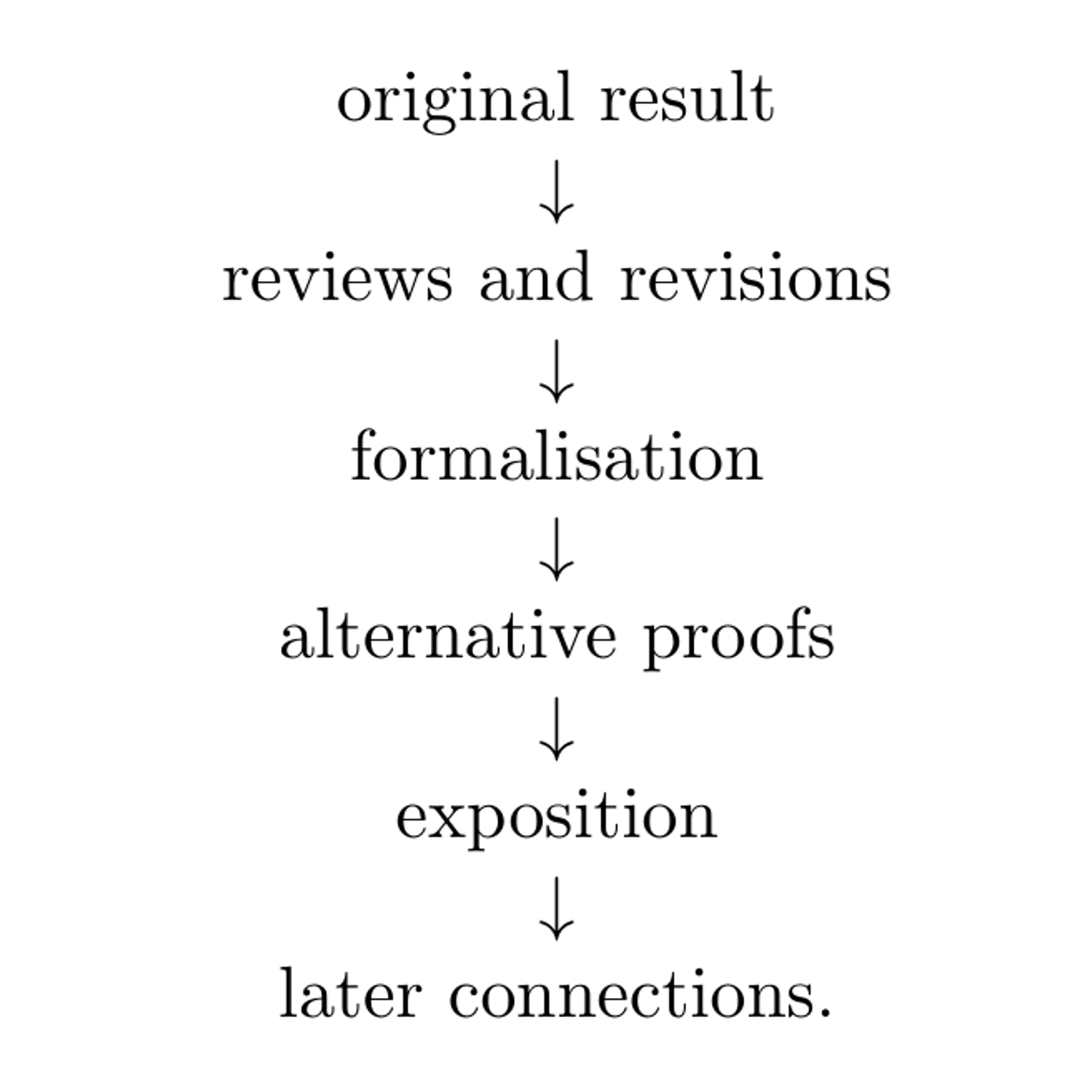
What is mathematical expertise worth when advanced mathematics becomes available on demand? Tristan Pryer argues that automated tools are separating activities traditionally bundled together in the mathematician’s work, including calculation, proof, verification and explanation. As producing results becomes easier, connecting them into coherent theories and understanding when they apply become relatively more valuable. This thought piece explores how universities, journals and mathematical careers could adapt, from education that develops independent mathematical judgement to review systems that combine automated checks with expert interpretation. Pryer also proposes a living scholarly record in which explanations, alternative proofs and later connections accumulate around a fixed, citable paper. Realising the benefits of widely available mathematical tools will require the judgement to choose appropriate models, question assumptions and interpret the results. Pryer argues that universities, journals and research organisations must deliberately reshape mathematical work so that greater capability also deepens understanding.
An Inverse Lyth Bound for Non-Attractor Inflation
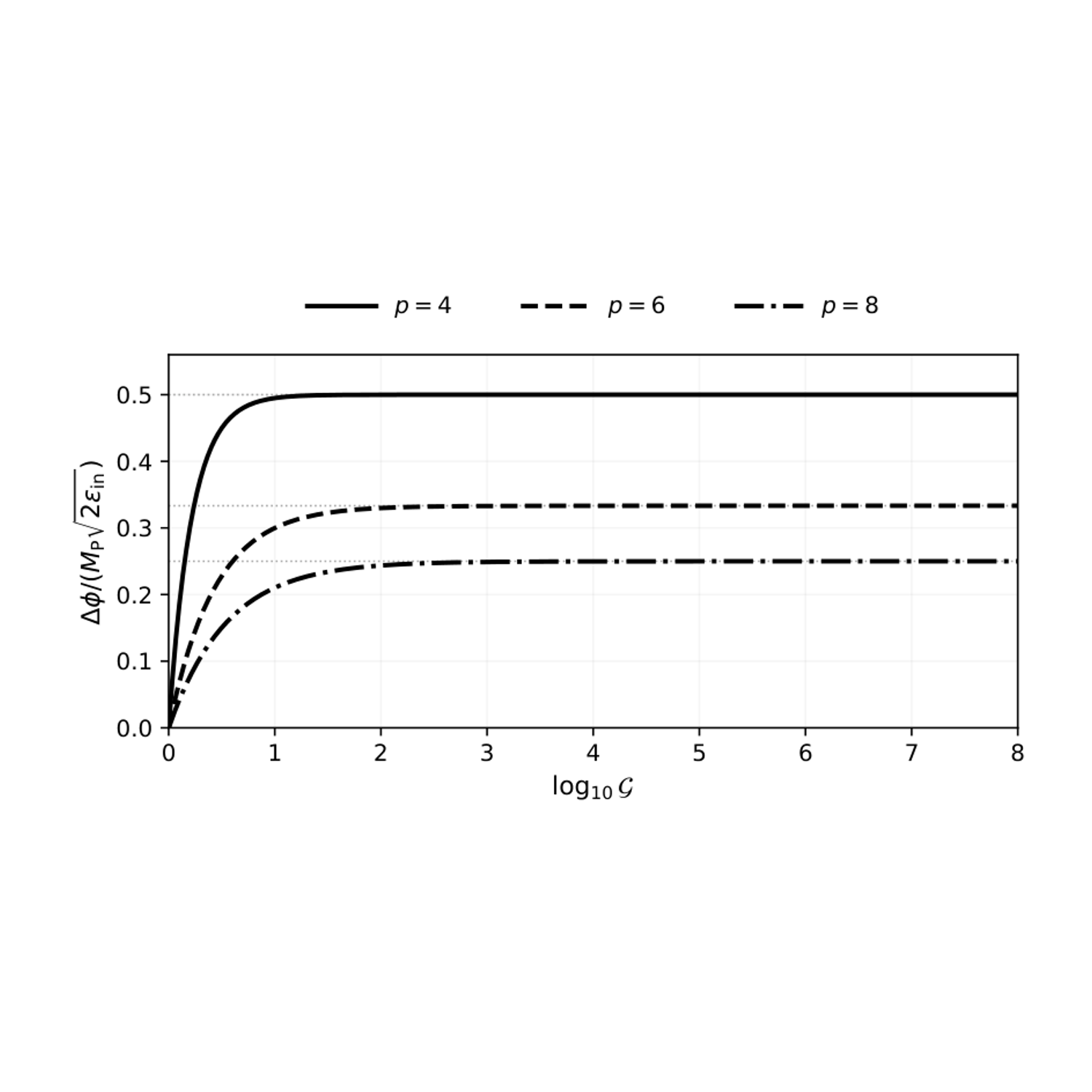
Inflation theory proposes that the early universe underwent a brief burst of rapid expansion, driven by a field called the inflaton. This study examines phases in which primordial fluctuations can strengthen even as the inflaton’s motion rapidly slows. It derives an upper limit on how much the field’s value can change during such a phase: the same dynamics that amplify fluctuations also drain the field’s kinetic energy, restricting its motion. This complements the familiar Lyth bound, which links primordial gravitational waves to a minimum field change in conventional inflation. Within the class of single-field models studied, the new bound holds regardless of the detailed shape of the field’s potential energy and does not require the usual slow-roll approximation. The result constrains models that amplify primordial fluctuations, including scenarios proposed to form black holes in the early universe. GPT-5.6 Sol identified and derived the central result; William H. Kinney subsequently checked the derivation independently, assessed its novelty and edited the manuscript.
AutoResearch vs Classical Hyperparameter Tuning
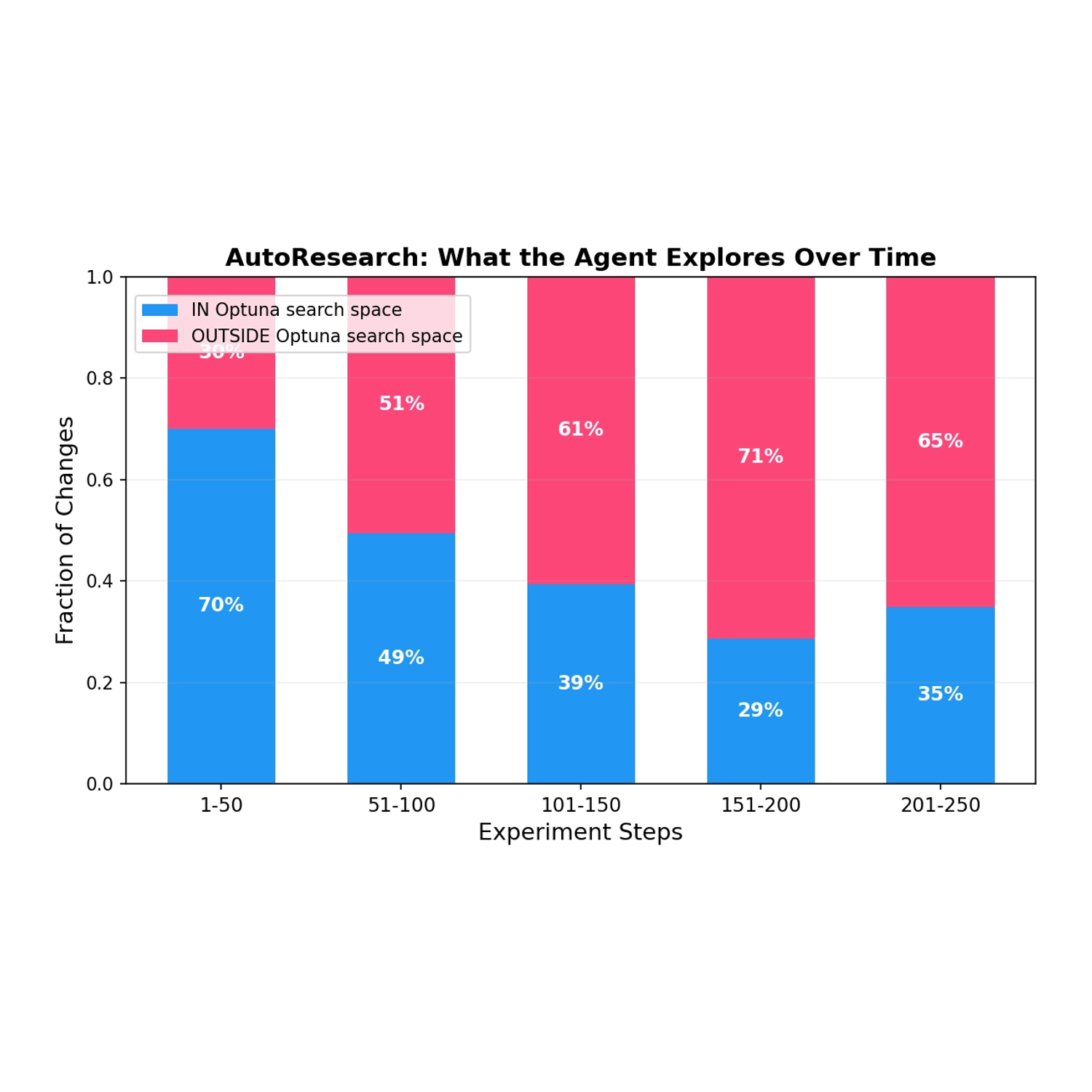
Can an AI research agent improve a machine learning system more effectively than conventional automated tuning? Zhengyao Jiang and Bingchen Zhao compared AutoResearch, an agent that edits code and tests the results, with Optuna, an established tool for searching predefined model settings. Using short language model training runs as a benchmark, they found that AutoResearch achieved better overall performance with fewer experiments and at comparable spending, even after accounting for the agent’s language model costs. Its selected solutions also retained an advantage when given longer training times. Although most improvements came from adjusting settings available to both methods, the agent achieved additional gains by identifying overlooked settings and making structural changes to the code. These results suggest that an important advantage of research agents lies in their ability to expand what is being searched as experiments proceed. The comparison covers one training task, however, and the authors note that conventional tuning could become more competitive when experiments are much cheaper to run.
Engineering the scientific method: software development practice for research with AI coding agents, from a search of public TESS data
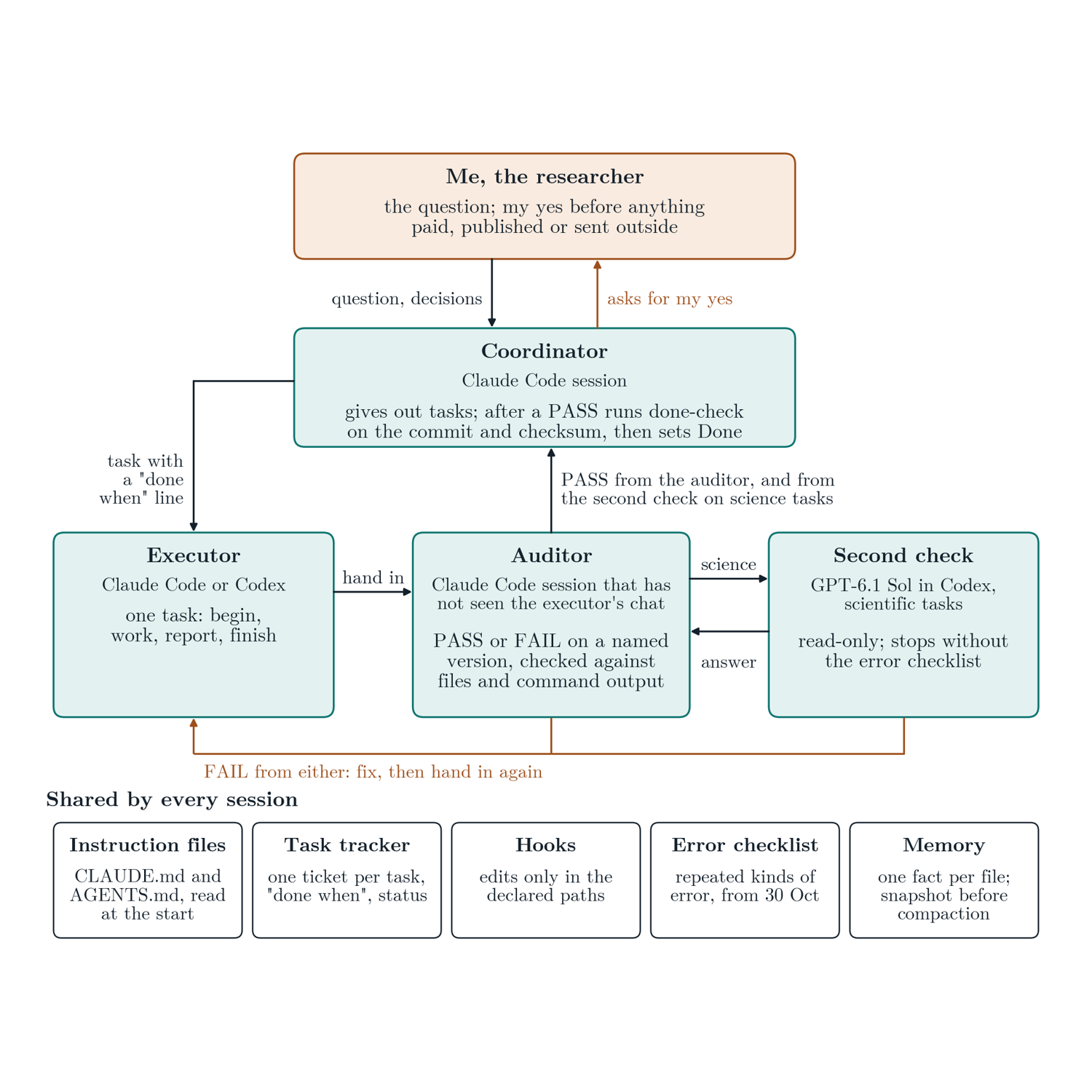
Repeated agreement between AI agents does not guarantee that a scientific result is correct. Pavel Rabtsevich examines seven weeks of AI-assisted research that began with a search for planets in data from NASA’s TESS space telescope. He adapted software development practices by assigning coordinator, executor and auditor roles, preserving the versions reviewed and turning earlier mistakes into a checklist for later tasks. A comparison with other stars undermined a published claim about how rarely noise could mimic a candidate signal, prompting him to withdraw that statistical bound. Another test exposed an error shared by two separately written programs because both relied on the same inappropriate software default. These cases highlight the value of checks that challenge shared assumptions, change the comparison or trace written claims directly to code and data. The paper provides practical templates for organising AI-assisted research, while acknowledging that a single project without a comparison group cannot establish how much the process improves reliability.
A Nilpotent-Type Skew Brace Whose Stable Left-Series Term Is Not an Ideal
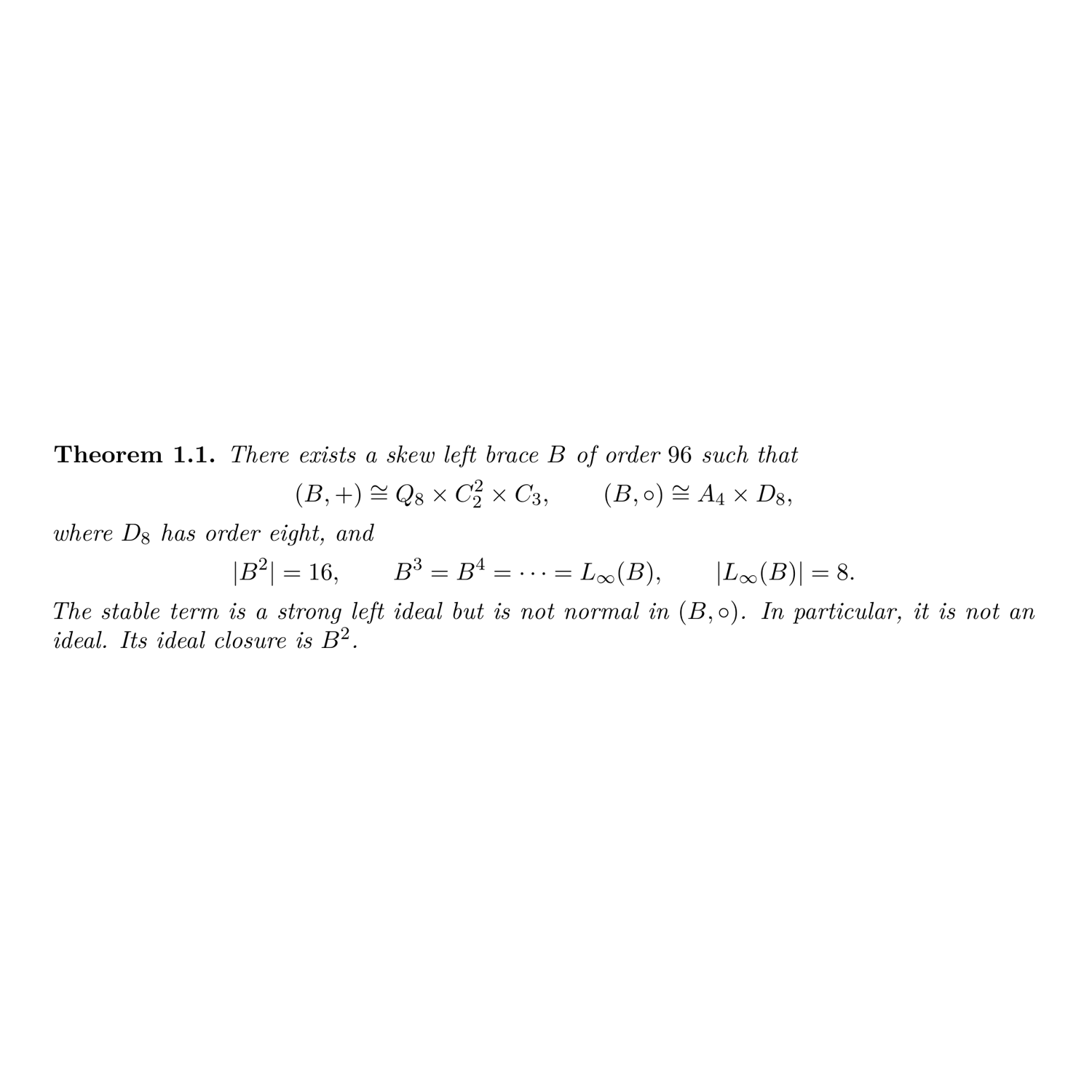
When can an algebraic structure be simplified without breaking its rules? Skew braces combine two linked group operations on the same set. For finite skew braces, a procedure called the left series produces a descending sequence of subsets that eventually stops changing. A conjecture proposed that, for the class known as nilpotent type, this stable remainder would always be an ideal, allowing mathematicians to form a simpler structure while preserving both operations. Bojan Tunguz disproves the conjecture with an explicit example containing 96 elements. Its left series shrinks to 16 elements, then eight, and stabilizes, but the eight-element remainder fails a required symmetry condition under the multiplicative operation. The smallest ideal containing it instead has 16 elements. Developed with assistance from OpenAI Codex, the work provides a direct mathematical proof, accompanied by a Lean formalization of every numbered result and independent Python and GAP checks. The example establishes that the stable remainder and the ideal needed for this simplification can be different.
A catalogue of 166 candidate new impact sites on Mars from repeat Context Camera imaging
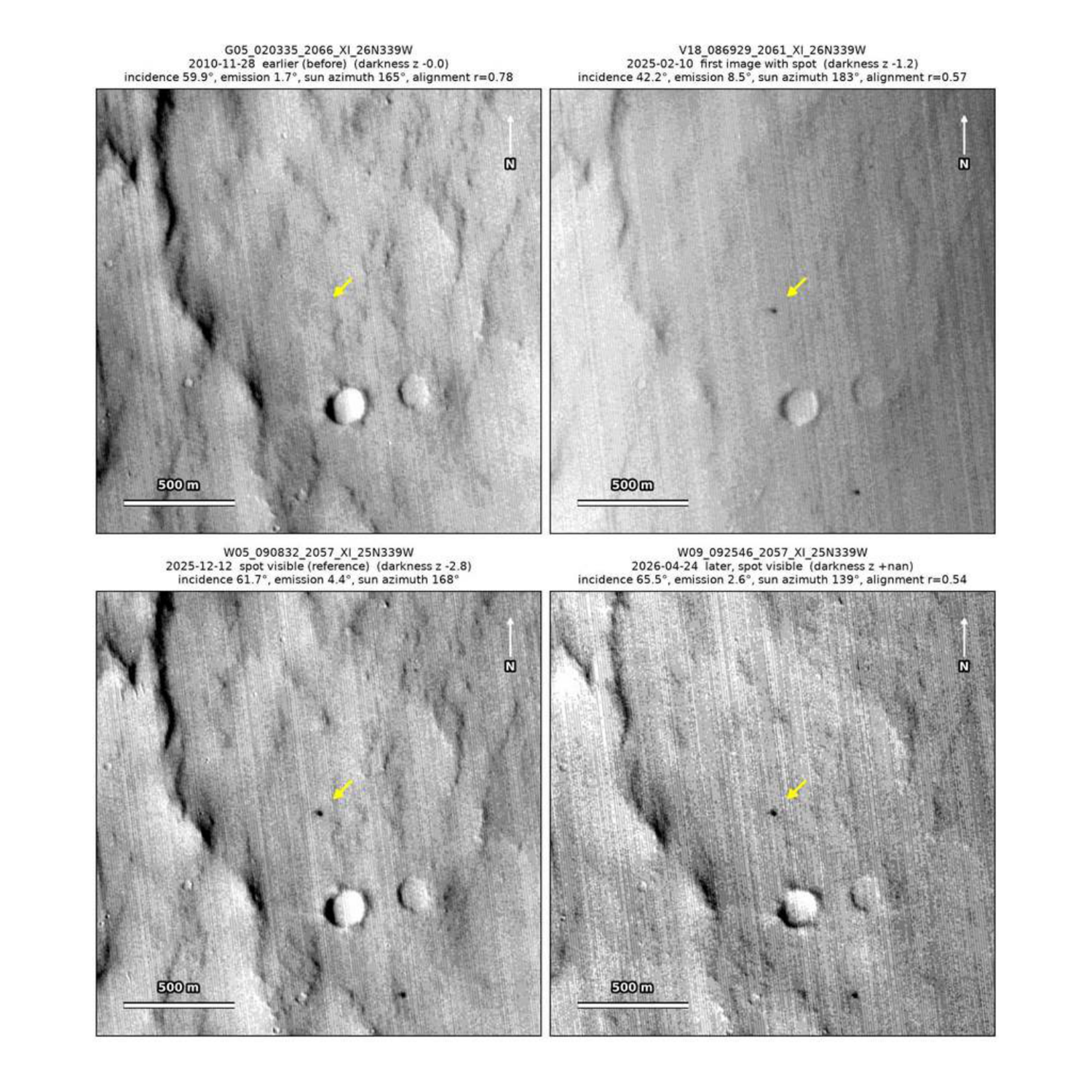
Small impacts on Mars can leave dark patches far larger than the craters themselves, making them detectable in repeated orbital images. Paata Ivanisvili used AI agents to compare 8,587 pairs of images from the Mars Reconnaissance Orbiter’s Context Camera, searching for newly appearing dark spots. The search identified 166 candidate impact sites not found in the public records examined, including 80 rated as strong candidates. Under the author’s direction, the agents analysed images, assessed alternative explanations and assembled evidence documenting each site’s location and possible formation dates. Six candidates also appear in existing images from the higher resolution HiRISE camera; two show small pits at the centres of their dark patches, strengthening the case for impacts. All 166 remain unconfirmed, because wind, dust movement and other processes can produce similar changes. The catalogue provides targets for follow up imaging and illustrates how AI assisted searches can turn extensive planetary archives into specific, testable leads for discovery.
A catalogue of 58 candidate stellar anomalies from Gaia and public time-domain surveys: long dimmings, microlensing-like brightenings, slow changes and possible dark companions
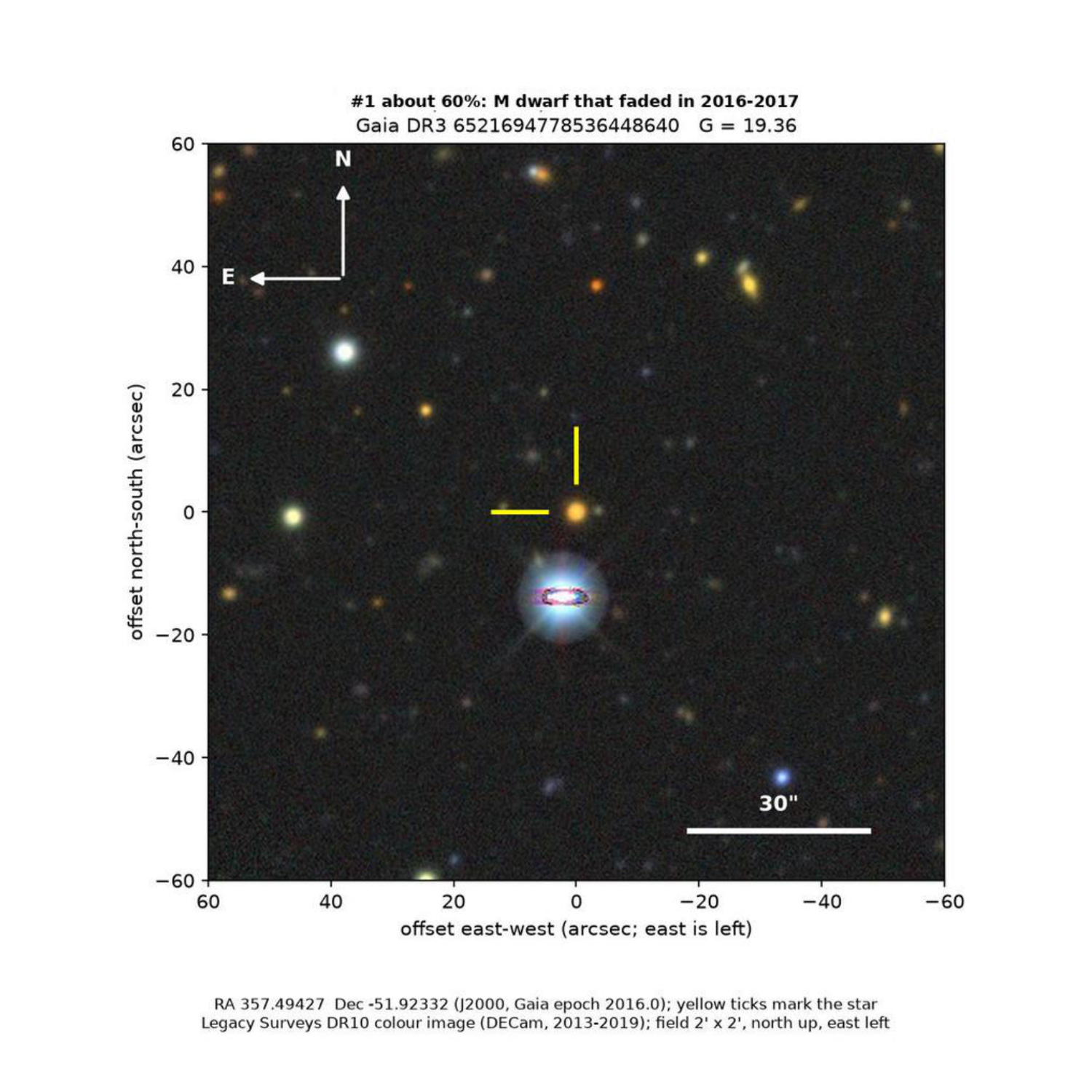
Why do some apparently steady stars dim for months or brighten just once? Paata Ivanisvili directed AI agents to search Gaia, the Zwicky Transient Facility and other public astronomical archives, assembling a catalogue of 58 candidate stellar anomalies. These include 37 prolonged dimmings, four brightenings resembling gravitational lensing, where a foreground object’s gravity magnifies a background star, and eleven stars whose reported orbits suggest unseen companions. One star faded by roughly half in red light within a day and recovered over several months. Comparisons across instruments support many of the brightness changes, with intervening dust a leading explanation for the dimmings. Their physical causes remain uncertain, however, and the possible dark companions are weak candidates. One dimming was also found to have been published previously. By documenting the observations, alternative explanations and remaining uncertainties, the study provides a shortlist for follow-up observations and illustrates how supervised AI searches can help identify unusual behaviour within extensive astronomical archives.
ASCEND: Personal AI Agents for Autonomous Scientific Computing Across HPC Clusters and GPU Workstations
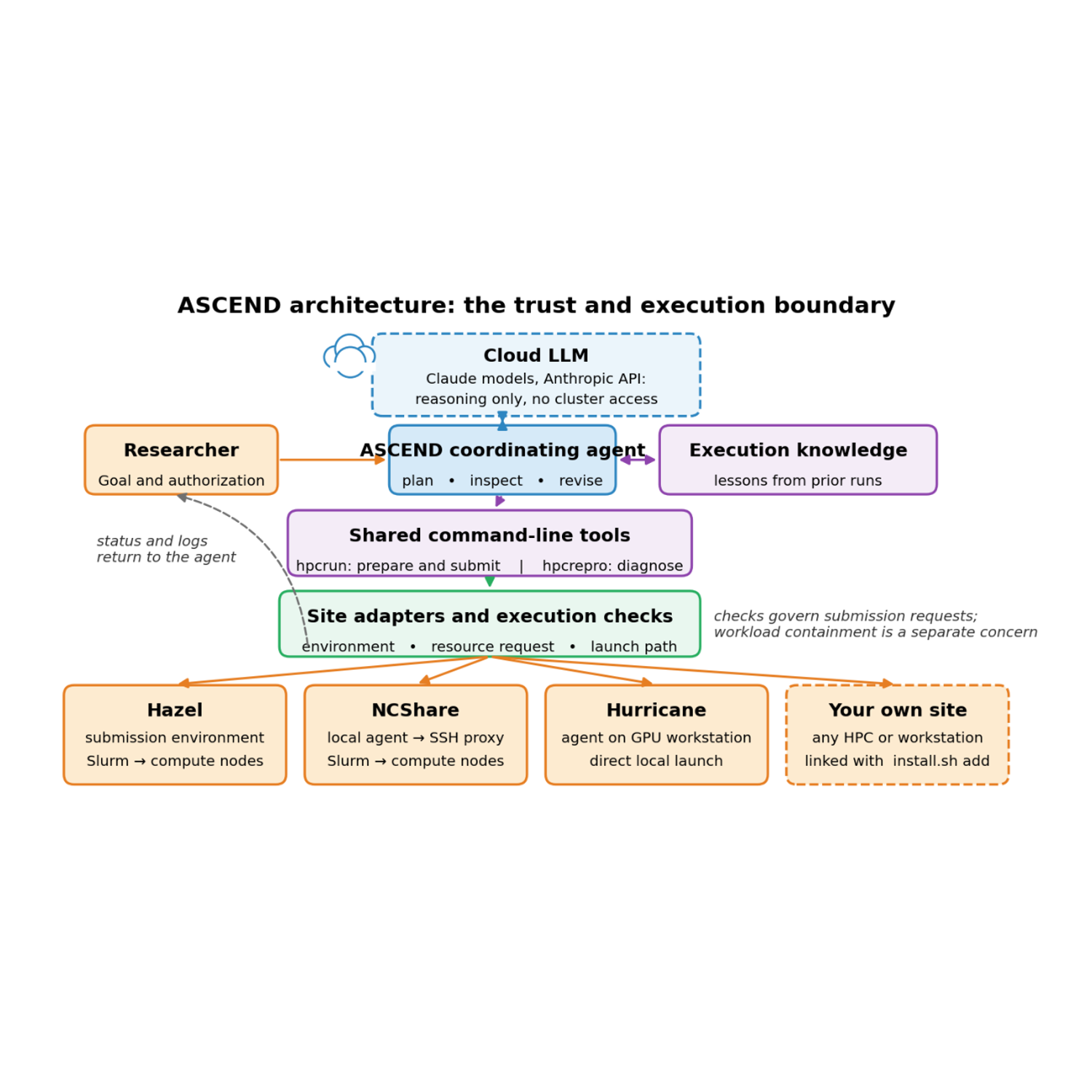
Running a scientific computation often requires researchers to configure software, request computing resources and diagnose failed jobs. J. Paul Liu and colleagues present ASCEND, a system that lets researchers delegate these tasks to AI agents operating from a personal laptop through existing accounts on computing clusters and workstations. In four author supervised cases using Claude Code, the system repaired a deliberately introduced computing fault, reproduced a published weather forecast evaluation, accelerated a geophysical simulation and uncovered defects in its underlying software. The simulation’s runtime fell from approximately twelve hours to two, while checks against a repaired reference version confirmed matching exported results. Two previously undetected software defects were also identified, including one that silently altered simulated flows. These demonstrations illustrate how agents could reduce the practical burden of scientific computing while helping researchers examine the reliability of existing code. However, full agent transcripts were not retained, so the amount of human assistance cannot be independently established, and broader testing is needed to measure how reliably the system completes unfamiliar tasks.